The Root Force Culture Initiative
Incredible Result: “Loyalty to our Company is so strong that our Customers and our Team don’t even think of switching.”
Avoidable Train Wreck: Poor Company culture deflates your team performance and customer loyalty.
Main Play: The “Root Force Culture” Initiative
What This Is:This program, taught to your Profit Strategy Team, puts into practice a profitable, innovation–minded culture driven by the seven Root Forces necessary today for companies to attract and retain great talent and customers and to profitably and quickly grow in the marketplace.
Since my Dad seemed determined that my brother and I would understand business, he often had us tag along when he made his rounds through the Food Center supermarkets.
Each store, to an eight year old, looked like an organized beehive of hard work and activity. And they all seemed to know my Dad – and he knew all of them.
There was something about the atmosphere at the Niemann Food Centers. There was great respect and compassion for others. There was a great trust amongst the people who worked there. There was a generosity of spirit and a dedication to hard work in making the business successful for everyone concerned.
Little did I know or understand everything that it took to keep this business successful and growing. At that time in 1964, there were over seventy grocery stores in my home town of Quincy, Illinois. Of those that existed then, only two of them are still in business today, ours and one other. As I learned over the years, the supermarket business is a tough business. With strong competition and net margins of approximately one percent, this is a business sector which clearly requires a lot of tenacity and courage to be and to stay successful.
So how did my Grandfather, my Dad and my Uncle not only survive, but continue to successfully grow their supermarket business throughout the region, while so many others fell by the wayside.
Niemann Food Center clearly had a great culture.
Much has been written about various aspects of the importance of culture. Over the years of working with business owners, leaders and family, I have also seen that time and again the great successes can be traced directly back to the great culture which permeated the organization. While at the same time, I have seen that the many failures which business owners have described when they have come in to meet with me can be directly traced to the seen and unseen negative forces which have existed within their culture.
The “Root Force Culture” Initiative
“Culture is my main focus as CEO”, says Roman Stanek, founder and CEO of GoodData. Yet, HubSpot CEO Brian Halligan contends “that 99% of companies are kind of stuck in the ‘90s when it comes to their culture.” He believes “Companies need to change the way they manage and lead to match the way that modern humans actually work and live.” How can we do this?
Zappos is a great example. Its “fun and weird culture” has landed it on Fortune’s 100 Best Companies To Work For® list for seven years in a row. They recognize how a “strong company culture can improve employee engagement, increase productivity, promote brand loyalty and enhance financial performance.” As Zappos points out, this all begins with a “deep discussion” of the company’s core values, the “heart of a company culture”.
Culture - The 7 Root Forces
As I have studied this, both with regard to the organizations which I work with, as well as my research into the reasons for success and failure of other lasting organizations, I have found that I can trace all of the successes back to seven root causes within an organization. The truly successful organizations have all seven of these positive root causes (what I call “root forces”), while one or two of these may be predominant.
The seven destructive root forces of behavior and attitude discussed earlier are the mirror image, or exact opposite, of the seven positive root forces which energize the organization. These are as follows:
| The 7 Destructive Root Forces | The 7 Energizing Root Forces |
| 1. Hubris | 1. Tenacity |
| 2. Contempt | 2. Respect |
| 3. Mistrust | 3. Trust |
| 4. Contentment | 4. Enthusiasm |
| 5. Indifference | 5. Compassion |
| 6. Greed | 6. Generosity |
| 7. Fear | 7. Courage |
Each Destructive Root Force is overcome by the owners, leaders and family within an organization when they think, act and lead in accord with these seven Energizing Root Forces.
These extremely strong negative and positive elements of culture permeate both the organization’s Dynamic Leadership Core (emanating from owners, family and leaders) as well as its Business Model Command (being reflected in how all personnel treat each other as well as how they treat the organization’s customers and key partners).
For example, if the organization’s owners, leaders and family are greedy, this will negatively affect pricing considerations for customers and key suppliers and compensation for personnel, and it may jeopardize business cash flow retention needs. If they demonstrate an atmosphere of mistrust, this will permeate the interactions of everyone throughout the entire organization.
The seven Destructive Root Forces and the seven Energizing Root Forces which I have discovered in my research are essentially the business version of the same seven fundamental traits or behaviors which have long been reflected in the culture of our societies.
For example, Christianity has long referred to the personal equivalent of these as the seven Deadly Sins, which are the opposite of the seven Lively Virtues, the roots from which all bad behavior and attitudes and good behavior and attitudes emanate.
Some version of these seven root faults and countervailing root virtues have also been at the center of societal woes and triumphs for thousands of years, as reflected in various literature. For example, Homer’s Odyssey, Dante’s Divine Comedia, Chaucer’s The Parson’s Tale, Milton’s Paradise Lost and C.S. Lewis’ Chronicles of Narnia all devote serious attention to them.
These seven behaviors are the origin of all other behaviors and attitudes. They underlie other behaviors and attitudes. They are the root cause or root force behind all other behaviors and attitudes.
It readily follows that these seven root behaviors and attitudes of human activity exist in the behavior behind business activity. To deny the impact is at the heart of companies which fail.
Visualizing The Impact Of A Company’s Culture
We can turn to nature in many ways to see the 3 ingredients necessary for life. Let’s choose the tree as our illustration for the life and success of your Company.
The tree’s life is dependent on 3 main ingredients – its roots (which fuel it), its trunk (which supports and guides it) and its branches (which reflect its life and which feeds it).
We can easily visualize The Pioneer Success Formula through the visual of a tree:
Impact Of The 7 Energizing Root Forces
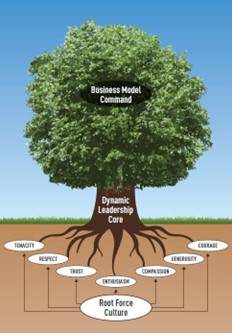
These 7 Energizing Root Forces are critical to the successful life of your business.
The destructive impact of the seven Destructive Root Forces on your Business Model and on your Leadership Core can be visualized as shown below:
Impact Of The 7 Destructive Root Forces
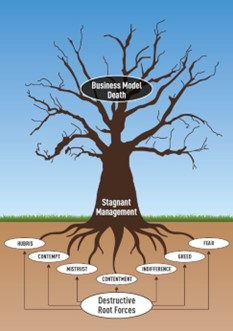
The 7 Destructive Root Forces kill your business.
The 7 Energizing Root Forces Illustrated
We are interested in how to grow your business. Let’s look at the seven Energizing Root Forces.
1. Tenacity: Persistent commitment and determination without unfairly glorifying one’s own self.
The Root Force of tenacity can begin with Jeff Bezos, the founder and CEO of Amazon. The story of Amazon is well known and doesn’t need to be repeated here. Brad Stone, author of the book The Everything Store: Jeff Bezos and the Age of Amazon (2013) describes Amazon’s culture as “notoriously confrontational, and it begins with Bezos, who believes that truth shakes out when ideas and perspectives are banged against each other.”
Amazon lives by 14 leadership principles, which are the Company’s highly prized values, which are often discussed internally and drilled into new hires. One of these reads as follows:
“Have Backbone; Disagree and Commit. Leaders are obligated to respectfully challenge decisions when they disagree, even when doing so is uncomfortable or exhausting. Leaders have conviction and are tenacious. They do not compromise for the sake of social cohesion. Once a decision is determined, they commit wholly.”
Tenacity is clearly one of the principal Root Forces which permeates the culture at Amazon. As Stone points out, “Some employees love this confrontational culture and find they can’t work effectively anywhere else.” Tenacity doesn’t need to be too confrontational. When it is, the Destructive Root Forces are starting to creep in.
Seth Godin points out that “tenacity is not the same as persistence. Telemarketers are persistent. Nike is tenacious”. (SethGodin.typepad.com)
Tenacity was evident in the approach taken by Michael Cullen when he launched the supermarket Business Model. An excerpt from a 1930 King Kullen newspaper advertisement read: “It’s you folks I want to please. The service grocery chain stores oppress the poor and are a menace to the nation. Are you with me?”
2. Respect: Deep admiration and patience towards someone or something.
“At the core of that call is respect,” accordingly to Headsets.com Founder and CEO Mike Faith, as reported in Small Business Trends - “Building a Company Culture of Respect” (January 13, 2011). “The customer deserves our respect. Sometimes they could be wrong. But they always deserve our respect.” According to Faith, Headsets.com is “Dedicated to customer love. And respect for customers is at the core of that love.”
As Small Business Trends points out, to ensure that disrespect is a rarity, Headsets.com is extremely rigorous in how they screen and hire candidates. Before they are hired, candidates go through what Faith calls “a day of customer service tryouts” to determine if they are a “fit” for the Headsets.com culture and customer commitment. Only 1 in 30 applicants who have gone through their customer service tryouts makes it into the Company as a headsets.com rep. Is this effective? Headsets.com, which focuses on selling headsets through the internet and their inbound telecom service, is on the 2016 Forbes List of Best Small Companies. It has grown from a $40,000 investment in 1998 to $26 million in revenue in recent years. (www.smallbiztrends.com).
On August 16, 1912, Glen L. Martin formed the Glen L. Martin Company in Los Angeles, California. He had just finished building his first plane in a rented church and decided to take a leap of faith on his risky but innovative new aircraft design – at the urging of Orville Wright.
Four months later and 400 miles away, on December 19, 1912, Allan and Malcolm Lockheed established the Alco Hydro-Aeroplane Company (which they later renamed Lockheed Aircraft Company). They had set up a shop in a garage, constructing sea planes.
As aircraft manufacturing giant Lockheed Martin International states on its website: “A church and a garage. These were humble beginnings. But these were also men of unrelenting vision and unwavering purpose.”
Today, Lockheed Martin says it operates its Company on the basis of three core values: “Do What’s Right”, “Perform With Excellence”, and “Respect Others”. As the Company describes, we “believe that respect – for our colleagues, customers, partners, and all those with whom we interact – is an essential element of all positive and productive business relationships.”
“If you want people to act like adults you need to treat them like adults.” This is according to Ricardo Semler, CEO of Semco, a Brazilian conglomerate which specializes in various complex technologies and services such as marine pumps, commercial dishwashers, digitals scanners, filters, mixing equipment, manufacturing liquids, powders and pastes for a variety of industries, logistics and information processing systems, inventory and asset management, biofuels and about another 2,000 different products.
In 1982, at the age of 24, Ricardo Semler took control of Semler & Company, a business which had been founded by his father. Up until then, the Company’s organizational structure was a paternalistic, pyramidal hierarchy which had been led by a very autocratic leader. When the younger Semler took office, he instituted a dramatic organizational restructuring. He immediately fired two-thirds of the top management and, in the years which followed, dismantled the rigid management structure which his father had imposed, replacing it with a very flexible organization based on three core values – employee participation, profit sharing and the free flow of information.
Semler felt that all people desire to achieve excellence. He believed that autocracy stifled motivation and creativity. Semco became a self-managed company. Workers chose what they do as well as where and when they will do it. Subordinates review their supervisors. The Company operates like a democracy, with the workers electing the Company’s leadership.
When Semler first proposed his ideas, it was rebuffed by his managers. But Semler was clear: “Don’t you think they know how to manage their own work?” This is the Root Force of respect. With several hundred million dollars of revenue per year, it appears to work very well.
3. Trust: A positive and kind faith in the reliability, integrity, and strength of someone or something.
Starting as a small shoe retailer in 1901, the American upscale fashion retailer known as Nordstrom grew to over 250 stores operating in over 30 States in the United States and Canada.
This $14 billion annual revenue company is described this way by Harry Mullikin, Chairman Emeritus of Westin Hotels: “Nordstrom has the faith and trust in its front line people to push decision-making responsibilities down to the sales floor. The Nordstrom shopping experience is “as close to working with the owner of a small business as a customer can get.” (The Nordstrom Way: The Insiders Story Of America’s #1 Customer Service Company).
For years, this trust as a Root Force of Nordstrom’s success has been reflected in its very simple Employee Handbook (printed on a single five – by – eight – inch grey card), which was given to all new employees and which contained Nordstrom’s one and only rule:
“Nordstrom Rules: Rule #1: Use best judgment in all situations. There will be no additional rules.”
In explaining its culture, Nordstom’s website explains “We trust each other’s integrity and ability. Our only rule: Use good judgment in all situations.”
How is trust built within an organization. One critical step is to simply share. As social media expert Dave Kerpen, Chairman of Likeable Media, points out, “Sharing breeds trust, and trust breeds business.”
4. Enthusiasm: Great excitement for diligently achieving a purpose or cause.
Bain & Company, the well known consulting firm, dealt with enthusiasm in a company publication called “The Chemistry Of Enthusiasm – How Engaged Employees Create Loyal Customers” (2012). As Bain explains: “Organizations had been trying for years to cultivate employee engagement … Engaged employees go the extra mile to deliver. Their enthusiasm rubs off on other employees and on customers.”
Bain has developed a way to measure this, using a metric which it calls the “Net Promoter Score (NPS). It consists of a single question asked of customers: “How likely are you to recommend [ this company or product ] to a friend or colleague?” On a scale of 1 to 10, respondents giving a grade of 9 or 10 are considered “promoters” – the company’s most devoted customers. Those scoring their experience at 7 or 8 are considered “passives”, and those scoring it from 0 to 6 are “detractors”. The NPS is the percentage of promoters minus the percentage of detractors.
As Bain explains, “promoters” are “enthusiastically loyal to the brand, the company and the product. They sing the Company’s praises to others and they buy more and stay longer.” By contrast, detractors “actively tell others about their terrible experiences.” Bain finds that organizations with highly engaged employees “often seem to be powered by an inner force, a mantra that crystalizes the Company’s processes and employee behaviors into a compelling summation of ‘what we’re all about.’ ”
5. Compassion: A proper balance between one’s self and the rights and needs of others.
While some managers may shy away from compassion (as if this might appear weak), a new field of research is showing that organizations which promote a culture of compassion, rather than a culture of stress, create a happier workplace and a better bottom line.
Mark C. Crowley, the author of Lead From The Heart: Transformational Leadership For the 21st Century makes this abundantly clear. He explains that companies “are focusing on innovation and unique differentiation – and almost exclusively are looking at people, not machines, to provide it.” He goes on to explain that “as workers have become increasingly more critical to the overall success of their organizations, what they need and expect in exchange for their work also has profoundly changed … They want to feel valued and appreciated by their leaders, and to know their work has significance.” Crowley concludes that “future leaders in all workplaces will be required not just to have strong minds, but also generous and caring hearts.” (Mark C. Crowley, Why Workplace Leadership Is About To Get Its First Major Makeover in 100 Years).
Crowley concludes that where “once the idea of appealing to the hearts of workers was seen as heresy, we’ve come to understand that it’s always been essential.”
In other words, an essential element and one of the critical Root Forces which company cultures need to embrace is that of compassion.
6. Generosity: The habit of giving more value than you expect to receive in return.
Normally when generosity is discussed we think of gifts of money or charity. However, in the context of culture and leadership which builds and executes great Business Models, our focus is not limited to gifts having a monetary value.
As Bruna Martinuzzi, the author of The Dealer As A Mensch: Become The Kind Of Person Others Want To Follow says, generosity is “giving someone a chance; giving someone the benefit of the doubt; and giving others a reason to want to work for you.” She goes on to state that it “entails giving others latitude, permission to make mistakes, and all of the information that they need to do the job.” She suggests that “in a nutshell, all of this translates to generosity of spirit, a quality we admire in leaders.”
Bruna explains “a leader with a generous spirit” understands that most people want to feel that they are a part of something bigger and something better and “connects the dots for people – the dots that help them see how the work they perform, no matter how small it may be in the scheme of things, has a bearing on the ultimate vision of the Company.”
The Gallup employee engagement tool, the Q12 Instrument, is, I believe, largely a measure of whether this generosity of spirit is present in a company’s culture. The Q12 statements look at such factors as whether someone encourages an employee’s development, whether an employee’s opinions count, whether an employee has received recognition or praise for good work and whether the Company’s mission makes the employee feel his or her job is important. These factors are rooted in generosity.
7. Courage: Embracing purity of thought and action by confronting and overcoming perceived fear, popular opposition, inappropriate emotion, uncertainty and intimidation.
In his article CEOs Need Courage, Harvard Business Review contributor Jeffrey Pfeffer (September 27, 2011), after describing some notable examples of CEOs with courage, concluded: “What separates these CEOs from the pack is not just a more sophisticated and empirically accurate understanding of individual behavior and the sources of organizational success but also the courage to implement these insights even when, or particularly when, they seem to defy conventional wisdom.”
A.G. Lafley, former Chairman and CEO of Proctor & Gamble nailed the importance of the Root Force of courage within an organization in his book The Game – Changer: How You Can Drive Revenue And Profit Growth With Innovation. He stated “I have tried to promote a more courageous, more connected and collaborative culture – one in which people want to take risks to identify game-changing, life-enhancing innovations. It takes a certain kind of nerve to deal with the unknown, to work on the frontier … . Innovating can mean sticking your neck out; a courageous connected culture means it won’t get chopped off, and that you are not alone with taking risks.”
The Journal of Business Psychology has even published a study that attempts to quantify the degree of courage within an organization’s culture. It created what it calls the “Organizational Courage Assessment” (OCA) which defines four types of organizations: “Bureaucratic organizations (little fear with few acts of courage), fearful organizations (much fear with few acts of courage), courageous organizations (many courageous acts despite much fear), and quantum organizations (many courageous acts with little fear).” Developing and Validating a Quantitative Measure of Organizational Courage (2009).
Quoting Dr. Jim Harter, Gallup’s Director of Research, Crowley points out that “people will continue to be unhappy in their jobs (and therefore greatly underperforming) just as long as their leaders fail to be their advocates.” Citing a worldwide study by Towers Watson, the “single high ascriber of engagement today is whether or not workers feel their managers are genuinely interested in their well-being. Less than 40% of workers now feel that support.”
As Seth Godin points out, our “choice is to spend our time avoiding that fear or embracing it.” That takes courage.
The Prevailing Force
In most organizations that I studied, there occurred a Prevailing Force which had grown or developed on account of one or more of these Root Forces. In essence this Prevailing Force became recognizable as the personality of the organization. This Prevailing Force, when negative, has been the primary cause behind the underperformance, stall or failure. When positive, it has been the primary force behind the growth and ongoing success. This is illustrated in the examples discussed above.
This personality, when positive and intentional, often is reflected in the Company’s motto, tagline or advertising and permeates the entire design of the Company’s Business Model Command. RAM Trucks are “Guts, Glory” (Courage). Walmart is “Low Prices” (as a result of its Tenacity in controlling costs). Zappos is “Powered by Service” (Respect for its customers). The hugely successful Vala’s Pumpkin Patch in Omaha is “Your Fall Family Tradition” (Enthusiasm for the thousands of Nebraska families it serves). Toms Shoes is “Giving” (Generosity towards those without shoes). Salesforce.com is “Customer Success” (Trust by its customers in the service provided).
Often a positive or negative Prevailing Force existing at one stage of an organization’s life disappeared or was replaced by a negative or positive Prevailing Force later on during the organization’s life. Whether this was intentional or accidental depended on the strength of, and direction coming from, the organization’s Dynamic Leadership Core.
The 7 Energizing Root Forces in Action
While many focus on just one and sometimes two of these cultural ingredients as keys to organization success, longevity and growth, all seven Energizing Root Forces need to be key elements in an organization’s culture if the organization is going to successfully design and re-design (and execute) a great Business Model Command, enabling the organization to truly prosper and endure long term today.
Michael Cullen understood this – and he built his Company around this. In taking on the establishment in the grocery industry, he demonstrated the impact of putting the seven Energizing Root Forces into practice, both by sparking a massive change in that business sector, and by creating a Root Force Culture within his own King Kullen Company which has enabled it to continue to thrive to this day.
This Root Force Culture will permeate your Dynamic Leadership Core to enable it to design, innovate and drive the Business Model Command on which your Company depends.
The “One Thing” Game Changer
It was 9:00 on the night before the first day of school and my Dad was late getting home after a long business day. Bedtime for my brother Ferd and me, but we wouldn’t sleep without a nightly story from our Dad. As a military vet and former professional baseball player, his stories always took us back to some lesson learned in the Korean War or on the baseball field. He always spoke of the members of his platoon and teams as his family. They had a special bond with each other that my Dad spoke about throughout his life. To my Dad, “family” was a very broad, welcome reality.
In the popular 1991 movie City Slickers, the trail boss Curly (played by Jack Palance) kept insisting that Mitch (played by Billy Crystal) needed to find the “one thing” which would change his life (in our case, our organizations) to set it on the right course to lasting success. The movie never revealed what that one thing was. It was up to Mitch to figure it out.
I’ll tell you what it is.
There is one thing which will best enable every organization to create a Root Force Culture, meaning a culture which lives by every one of the seven Energizing Root Forces and achieves outrageous, lasting success. An organization where the seven Destructive Root Forces wither away or simply won’t take root.
This “One Thing” very simply is to realize, accept and act on the fact that we are all actually family. Family members should (and normally do) think and act towards one another according to the seven Energizing Root Forces. They are generous, compassionate, respectful, trusting and enthusiastic towards each other and will tenaciously and courageously help and defend each other. Members of great Family Business Pioneer families create a culture which helps them achieve amazing outcomes.
This isn’t really a new concept at all. Many organizations seek to achieve “family” status. In addition to the military and sports, we see this in fraternities and sororities, alumni, political parties, executive peer groups, social media groups, membership organizations, clubs, customer loyalty programs, national, state and local communities, and many other organizations.
Of course, unless your organization is already built on an “all one family” perspective, a change to this will involve some initiatives. I suggest that a simple mindset exercise is a great start.
If we actually believed that everyone both inside and outside our organization is part of our family, then our attitude and behavior towards each other will automatically reflect the seven Energizing Root Forces critical to outrageous success.
Is it difficult to believe we are actually one family? Society, culture and biases can make this more difficult than it needs to be. However, both religious faith and overwhelming recent scientific discoveries confirm our common ancestry.
An honest, heartfelt mindshift which actually sees everyone we encounter (team members, colleagues, customers, suppliers, partners, etc.) as part of our family puts us in a state of mind where the Energizing Root Forces fuel incredible results.
Related Attorneys