Understanding Your Business Model
Misunderstanding How Our Business Model Works
My Dad also owned and operated a small general merchandise and toy store called Shoppers Village, so I wasn’t surprised when in the fall of 1964 he brought home a set of building blocks and a model car kit. As someone who was always teaching me about business, he said “Here, see how you can use these to figure things out.”
I never fully understood this until 40 years later when I read Dr. Alexander Osterwalder’s 2004 dissertation “The Business Model Ontology – A Proposition In A Design Science Approach” (PhD thesis, University of Lausanne).
We can read a lot today about Business Models. However, until Dr. Osterwalder created a language and a structure around this, the study of Business Models had been replete with confusion, misunderstanding and a lack of the tools necessary to design, critique, analyze, innovate and develop Business Models.
To be sure, men and women have been designing and successfully operating businesses for eons. Men and women have also been watching their businesses crash and burn for eons. Many simply didn’t understand how their Business Model worked, i.e. how it created, delivered and captured unique value. Perhaps they were just content to follow or fearful of the risk of not following.
Many men and women in business, both today and in the past, have simply patterned their business after that of some other successful example, without necessarily caring to understand exactly how (or why) the business worked. For example, once the supermarket Business Model proved its case, copycats jumped on board and this new Business Model proliferated within a decade. Other examples abound. Once Groupon built a successful (or seemingly successful) Business Model, other imitators (called groupies, copycats or clones) flooded the market (e.g. LivingSocial, GroupPrice, PetSimply, Jdeal).
Definition Of A Business Model
However, to truly build any business which has unique long lasting capabilities, it’s necessary to understand the fundamental building blocks as to how any business is put together. Only by understanding the “how” of how a business actually works, can truly unique Value Propositions be developed as part of a truly unique Business Model which is fully capable of successfully creating, delivering and capturing full value.
Dr. Alexander Osterwalder set out in 2004 to define exactly what these building blocks were. His research lead to the following conclusions.
First, every business centers around four key epicenters:
- Offer - What is my offer?
- Customer - Who is my customer?
- Resources - What is needed to produce the offer?
- Finance - How is profit achieved?
However, this is not sufficient detail to produce a workable, useful framework. Instead, based on his research, Dr. Osterwalder found that these four epicenters need to be broken down into the following nine building blocks. (The related question is my summary of what each “building block” means and I’ve re-named his “Channels” to be “Customer Channels”):
Offer
1. Value Proposition – What do I sell?
Customer
2. Customer Segment – Who buys from me?
3. Customer Channels – How do I reach and deliver to my customers?
4. Customer Relationships – How do I keep my customers?
Resources
5. Key Resources – What do I use to make it?
6. Key Activities – How do I make it?
7. Key Partners – Who outside of my organization helps me do it?
Finance
8. Revenue Streams – How do my customers pay me?
9. Cost Structure – How do I control my costs?
He described these nine components as the building blocks of a Business Model. Apparently my Dad with his set of building blocks was onto something.
The Business Model Canvas
Had Dr. Osterwalder stopped here, his dissertation likely would have ended up in the heap of other doctoral dissertations. However, Dr. Osterwalder took a significant step forward by turning this list of components of a Business Model into a useful tool which business leaders can easily learn to use. He dubbed this the “Business Model Canvas” which looks like the following (with my nine descriptive questions inserted):
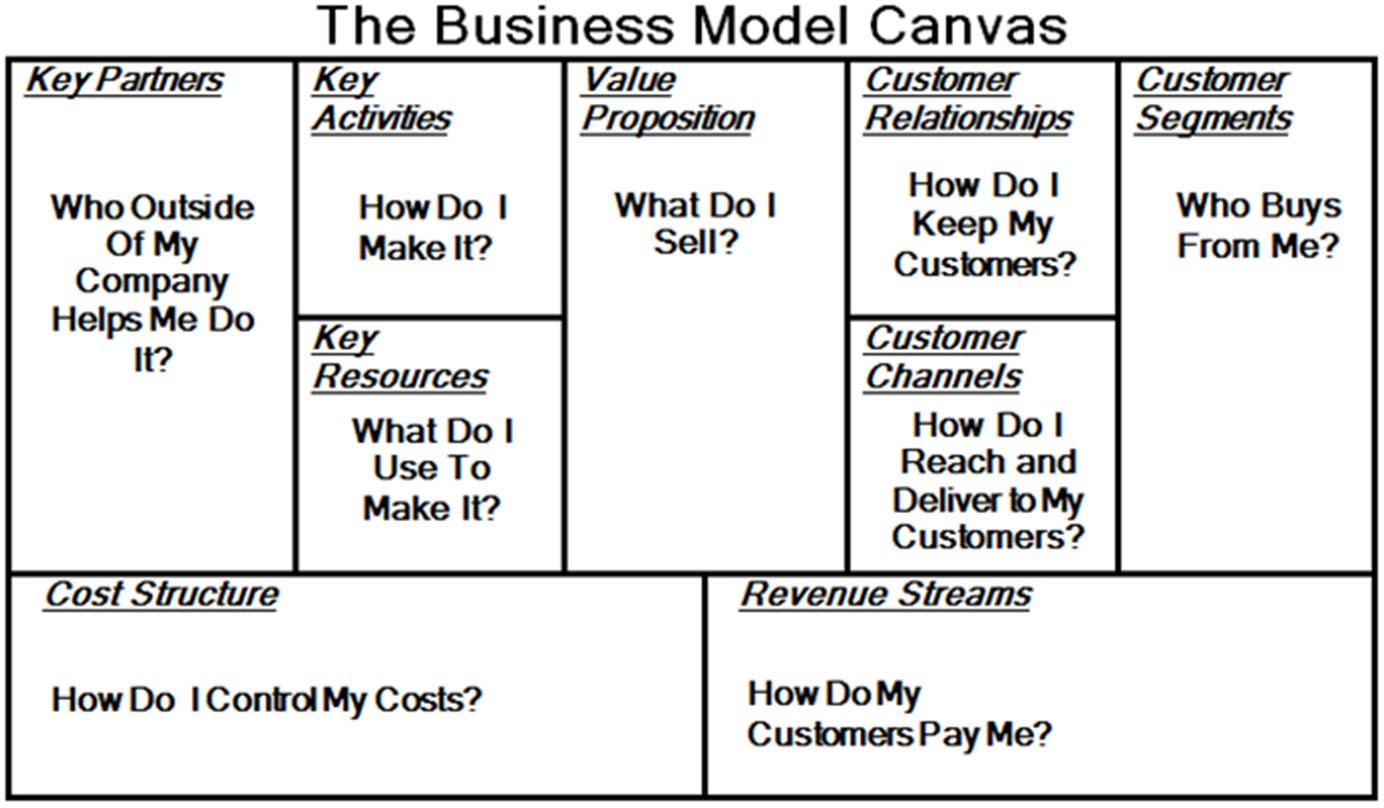
Source: www.Strategyzer.com.
Using this Canvas, any type of business, of any size, age, business sector, time and place, can be described, in its essence. This enables any business to be more easily understood by every member within the organization. And it enables every idea to be better evaluated.
This is critical to a successful business. If those within the organization do not truly understand how their business works – and what is necessary in order for it to work - the odds are that those working within an organization are pulling or pushing in opposite or competing directions, even though they seemingly believe they are actually helping the cause.
The Business Model Canvas can also be used by an organization’s leaders to meet their three principal obligations – to profitably preserve those parts of the business which should continue to be operated, to eliminate those parts of the business which no longer represent the organization’s sweet spot, and to create new parts of the business or additional businesses for the organization.
Business Model Thinking
Through the eyes of an eight year old back in 1964 living and working on our farm, I also experienced typical farm life which has served to help me to further understand and explain this whole concept of Business Models based on building blocks.
Besides being in the pony business, my parents also operated an egg production business, so we had a stable full of chickens. We also had, like every other farm in the area, our share of dogs and cats. And, besides the ponies, we had about a half dozen horses of various breeds.
So, how does this help us to understand Business Models? During my Boot Camps and Executive Briefings with business leaders, I pose the question to them that if they had to try to explain the concept of Business Models using different animals to do so, how would they do it. Many explain that each of these animals have a different value proposition or competitive advantage or key capability.
All are correct answers. However, the answer I’m looking for is that they all have the same “building blocks”. They all have bones, muscles, eyes, legs, stomach, heart, etc. These are the building blocks which are common to all of these animals. Yet, even though they are all based on the same set of building blocks, they do in fact all have unique capabilities and competitive advantages. They have been designed by God to accomplish or to serve uniquely different purposes within the overall ecosystem (but in each case using the same types of building blocks).
Likewise, whether you have a business which grows vegetables, packages meat products, provides consulting services, delivers packages, repairs automobiles or makes iPhones, each of your businesses is built on the same nine building blocks described by Dr. Osterwalder above.
Let’s take a look at how the easily understood grocery business can be described, using the Business Model Canvas.
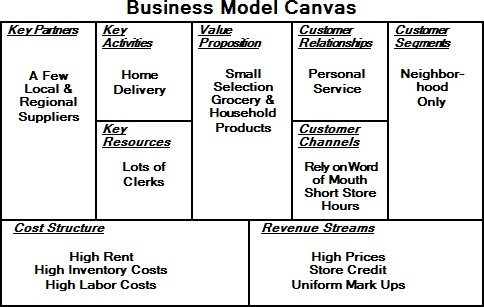
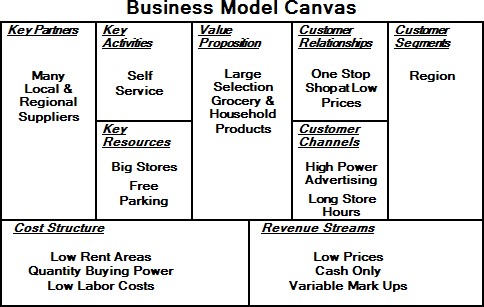
First, let’s compare the corner grocery store operated by Kroger and A&P throughout the country in 1930 to the King Kullen supermarket designed by Michael Cullen. These nine building blocks can be compared as follows, using the Business Model Canvas:
Kroger and A&P (1930)
King Kullen (1930)
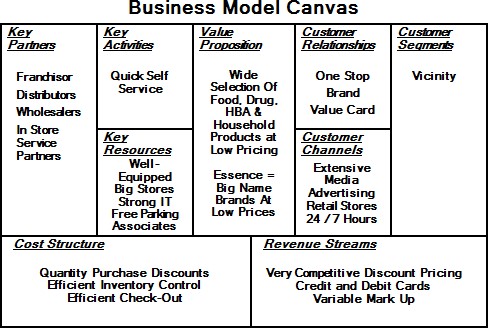
We can look at one of the supermarket Business Model grandchildren by looking at the current Cub Foods Supermarket:
CUB Foods (2017)
As Dr. Osterwalder began to speak to various groups around Europe about his Business Model Canvas concept, his audiences invariably asked “Where is your book?” They clearly did not want to read his technical dissertation.
The Business Model Generation Movement
Naturally, having become an expert on Business Model thinking, Dr. Osterwalder would be the last person to follow the normal route for authoring a book. Instead, he decided to enlist the help of other like minded practitioners from around the world. He opened a Business Model collaboration website and invited those of us interested to participate with him in developing what would become the first of its kind Business Model Handbook.
With his Business Model concept in mind, he offered a simple Value Proposition to those who wanted to participate. They would become named co-contributors in the handbook. His Customer Channel for reaching us was through the internet and email. Those who signed up also would become not just his Key Partners, but also his initial Customer Segments. By having us as a co-contributor team for the handbook, he developed a particularly sticky Customer Relationship. His simple (initial) Revenue Stream was a one-time entry fee which we paid to help fund the project. All of the co-contributors, as well as a group of closely-related professionals who had worked with Dr. Osterwalder, along with the Internet Hub, constituted the Key Resources. Dr. Osterwalder would propose and initially author certain “chunks” for the book, along with posing questions for consideration, which members of the Hub could respond and discuss online, thus constituting the Business Model’s Key Activities. Other Key Partners enlisted by Dr. Osterwalder included a select number of firms who could help to design and illustrate a unique new handbook. His Cost Structure was kept to a minimum through the efficient use of the website hub.
The project took us well over a year to complete. In the end there were 470 of us from 45 countries who participated as co-contributors to develop the handbook, which has been named Business Model Generation – A Handbook for Visionaries, Game Changers, and Challengers. Seventy-eight pages of the book can be viewed at www.Strategyzer.com. The handbook has become an international success, selling over 1,000,000 copies throughout the world. It has been translated now into 35 different languages.
The Business Model Canvas has been used by over 5,000,000 Business Model innovators (business pioneers, strategies, advisors, etc.). It is also now being used to teach business strategy at major universities. It can be used to describe the overall Business Model for the organization, as well as to describe various divisions, product lines and individual products or services.
Since its essence is to describe how something creates, delivers and captures value, it can also be used at an individual level to describe how any one individual creates, delivers and captures value, e.g. as an employee within a larger organization.
Recognizing this reality, a spin off handbook, led by Timothy Clark, in collaboration with Dr. Osterwalder, and using a similar co-creation Business Model approach, has been developed called Business Model You: A One-Page Method For Reinventing Your Career. This was co-created by 328 of us from 43 countries. It has become a very useful tool I use in business leadership development and succession planning (www.BusinessModelYou.com).
The latest spin off handbook is Value Proposition Design. This helps entrepreneurs to tackle a main challenge of every business – creating compelling products and services which customers want to buy.
Does everyone in your organization really understand your Business Model? Do they understand the Business Model of your competition? Is everyone on your team pulling in the same direction? Are you in command of your Business Model, which itself is the command center for the profitability and growth of your business?
Related Attorneys